
In this video you get to see the five VTEC machines battle against each other.
- Honda Civic Type R EK9
- Honda Integra Type R DC2
- Honda S2000
- Honda Prelude Type S
- Honda Accord Torneo SIR-T
Who won eventually....
http://videos.streetfire.net/
Friday, March 31, 2006
Honda VTEC Battle
Saturday, March 25, 2006
Mugen Civic Dominator
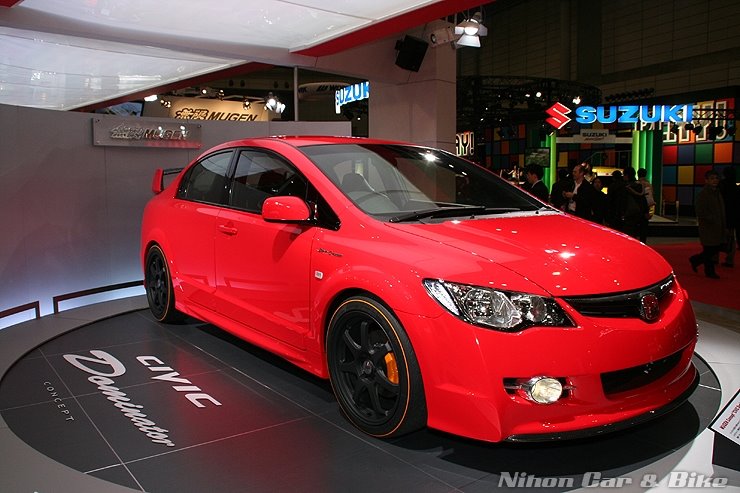
Mugen has presented the Civic Dominator at the Tokyo Auto Salon: the Mugen Prototype Civic Dominator, a real bomb that only Mugen could have made.
This Dominator has a Tune KA20 + Supercharger engine with a displacement of 2.0l and it develops more than 300bhp, hooked up to a 6-speed manual gearbox.
The brakes are from Brembo:
Pad : Type Competion
Rotor / FR : Active Gate Brake Rotors
Rotor /RR : 5-Slits Brake Rotors
Hose : Micro mesh brake lines.
Tyres and rims have these specifications:
Rims : 18 in X 8.0 JJ Forged Alloy Wheel "GP"
Tyres : 225 x 40ZR18 (Michelin).
For the aerodynamics, we have:
Front Bumper : Carbon Flat under floor bumper
Rear Diffuser : Carbon Rear Diffuser
Rear Wing : Carbon Active control rear wing.
It's Mugen's speciality to bring together power, technology and beauty, and this Civic Dominator proves that the manufacturer excells in this. Dressed in red, more specifically Fire Cracker Red, this monster sits on Michelin wheels that look the part on this Civic. The small yellow line really adds to the looks too. As stated above, the Civic has been kitted with body elements made out of carbon fibre, and one of the most important elements concerning the body kit is that the rear wing is adjustable to get the best performance and handling out of the Dominator. Last but not least is the central double exhaust, just like on the prettiest 2 and 4-wheeled vehicles.
We can say that this is a truly magnificent creation by Mugen...

The Mugen Civic Dominator Concept
8th Generation Civic Sedan in Singapore
The new Honda Civic FD is already in Singapore. I have seen quite a few on the roads of Singapore.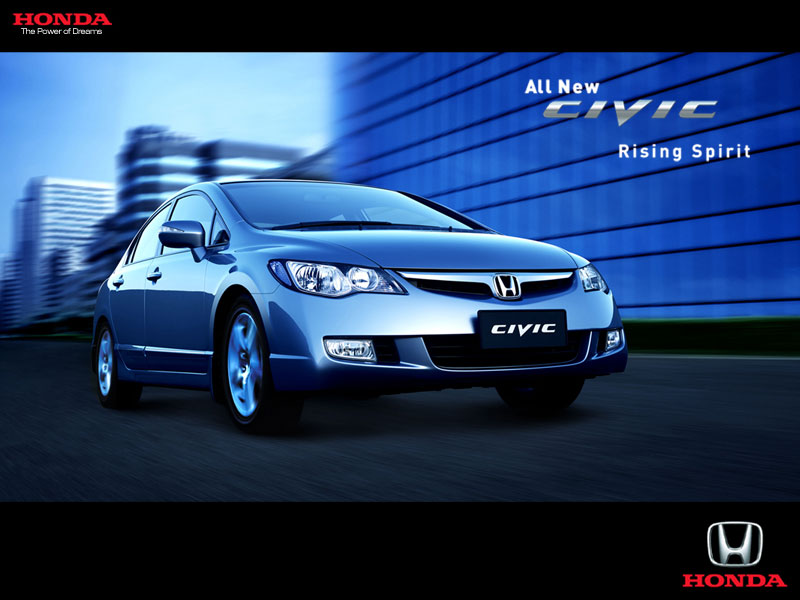
Labeled the 'Advanced Dynamic Sedan', the new Civic is available in two specifications;
Honda Civic 1.8L
- New 4 cylinder 16V chain driven SOHC i-VTEC engine (after 17 years) with a DBW (drive-by-wire) system.
Honda Civic 2.0L
- 4 cylinder 16V chain driven DOHC i-VTEC engine
Both come:
- a Multi-tiered dashboard display that positions the speedometer, and other frequently checked displays on an upper tier near the driver's line of sight for minimum eye movement while driving, whereas the tachometer, and other gauges are located on the lower tier.
- 5 speed automatic gearbox.
- Dual airbags, active headrest and ABS. However, the Civic 2.0L comes with extra side airbags.
Senior Managing Director and Chief Operating Officer of Honda Motor Co., Ltd.'s Asia-Oceania operations and also Asian Honda Motor Co., Ltd.'s President and Chief Executive Officer, Satoshi Toshida (He will take over as Chief Operating Officer of Honda Motor's global power products' operations on 1 April 2006):
"For many of our customers, the Civic defines Honda. When it was first introduced 34 years ago, the Civic quickly became Honda's first mass market automobile sold on a global scale. To date, over 16 million customers in some 160 countries have purchased it. Our goal for each new generation of the Civic is to achieve substantive improvements in all measures of an automobile's value, including driving performance, fuel economy, safety, environmental friendliness and packaging. In so doing, we want to ensure that each new generation of the Civic immediately sets a new, global benchmark for its category".
But too bad Singapore Kah Motor did not bring in the much more nicer Civic Si.
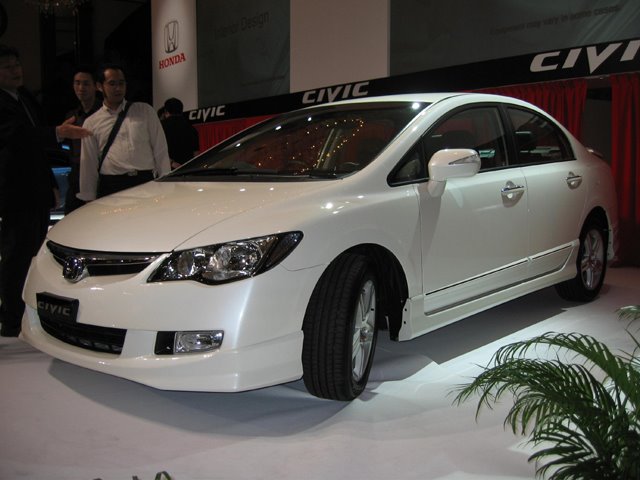
Some pics of the new civic launch in Singapore :

Monday, March 20, 2006
Honda VTEC Engine Codes And Specs
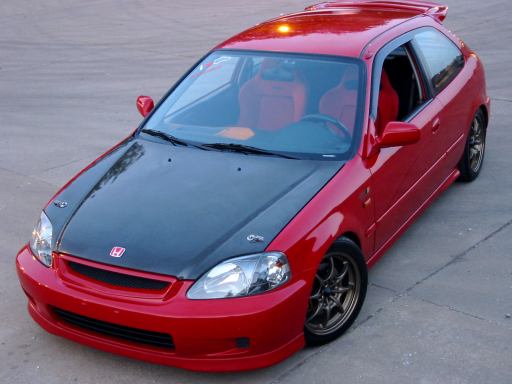
AP1 - '99 - '00 S2000 - 2l DOHC VTEC = F20C
BA8 - '92 - '96 Prelude Si SUPER EDITION PRIVATE STAGE = 2.2l DOHC = F22B
BA9 - '92 - '96 Prelude Si (4WS) = 2.2l DOHC = F22B
BB1 - '92 - '96 Prelude Si VTECS-LIMITED = 2.2l DOHC VTEC = H22A
BB4 - '92 - '96 Prelude Si VTEC (4WS) = 2.2l DOHC VTEC = H22A
BB2 - '92 - '96 Prelude Si = 2.3l DOHC = H23A
BB5 - '96 - '00 Prelude Si = 2.2l DOHC = F22B
BB5 - '96 - '00 Prelude Xi = 2.2l SOHC = F22B
BB6 - '96 - '00 Prelude SiR Type S = 2.2l DOHC VTEC = H22A
BB7 - '96 - '00 Prelude Si(4WS) = 2.2l DOHC = F22B
BB8 - '96 - '00 Prelude SiR (4WS) = 2.2l DOHC VTEC = H22A
CB3 - '92 - '96 Accord Si = 2l DOHC = F20A
CB3 - '92 - '96 Accord 2.0i = 2l SOHC = F20A
CB4 - '92 - '96 Accord Si(4WS) = 2l DOHC = F20A
CB4 - '92 - '96 Accord 2.0i(4WS) = 2l SOHC = F20A
CC4 - '92 - '96 Accord Si-Z = 2.3l DOHC = H23A
CC5 - '92 - '96 Accord Si-Z(4WS) = 2.3l DOHC = H23A
CD4 - '93 - '97 Accord EX = 2l SOHC = F20B
CD5 - '93 - '97 Accord 2.2VTE, 2.2VTL, 2.2 VTS = 2.2l SOHC VTEC = F22B
CD6 - '93 - '97 Accord SiR = 2l DOHC VTEC = H22A
CD7 - '94 - '97 Accord 2.2Vi = 2.2l SOHC VTEC = F22B
CD8 - '94 - '97 Accord SiR = 2l DOHC VTEC = H22A
CE1 - '94 - '97 Accord 2.2Vi, 2.2VTL, 2.2ViX = 2.2l SOHC VTEC = F22B
CF2 - '95 - '97 Accord SiR = 2l DOHC VTEC = H22A
CF4 - '98 - '00 Accord 2.0VTS, 2.0LEV = 2l SOHC VTEC = F20B
CF4 - '98 - '00 Accord SiR, SiR-T = 2l DOHC VTEC = F20B
CF5 - '98 - '00 Accord 2.0VTS(4WD) = 2l SOHC VTEC = F20B
CL1 - '00 Accord EuroR = 2.2l DOHC VTEC = H22A
CF6 - '98 - '00 Accord 2.3 = 2.3l SOHC VTEC = F23A
CF7 - '98 - '00 Accord 2.3(4WD) = 2.3l SOHC VTEC = F23A
CG6 - '99 - '00 Accord(???)
CH9 - '98 - '00 Accord SiR = 2.3l DOHC VTEC = H23A
DA5 - '89 - '93 Integra 4dr = 1.6l SOHC = Z16C
DA6 - '89 - '93 Integra 4dr = 1.6l DOHC VTEC = B16A
DA7 - '89 - '93 Integra 2dr = 1.6l SOHC = Z16C
DA8 - '89 - '93 Integra 2dr = 1.6l DOHC VTEC = B16A
DB1 - '91 - '93 Integra Esi = 1.8l DOHC = B18B
DB6 - '93 - Integra 4dr= 1.6l SOHC = Z16C
DB7 - '93 - '95 Integra Esi 4dr = 1.8l DOHC = B18B
DB8 - '93 - Integra Si VTEC, SiR, SiR-G 4dr = 1.8l DOHC VTEC = B18C
DB8 - '95 - '98 Integra Type R 4dr(96 spec) = 1.8l DOHC VTEC = B18C
DB8 - '98 - '00 Integra Type R 4dr(98 spec) = 1.8l DOHC VTEC = B18C
DC2 - '94 - '96 Integra Si VTEC 2dr = 1.8l DOHC VTEC =B18C
DC2 - '95 - '96 Integra SiR 2dr = 1.8l DOHC VTEC =B18C
DC2 - '95 - '98 Integra Type R 2dr(96 spec) = 1.8l DOHC VTEC = B18C
DC2 - '98 - '00 Integra Type R 2dr(98 spec) = 1.8l DOHC VTEC = B18C
DC5 - '01 - xx Integra Type R 2dr = 2.0l DOHC i-VTEC = K20
EC8 - '87 - '91 Civic GL 3dr = 1.3l SOHC = D13B
ED3 = '87 - '91 Civic GL 4dr - 1.5l SOHC = D15B3
EF3 - '87 - '91 Civic Si 3dr = 1.6l DOHC = Z16C
EF7 - '87 - '91 CRX Si 3dr = 1.6l DOHC = Z16C
EF8 - '89 - '92 CRX SiR 3dr = 1.6l DOHC VTEC= B16A
EF9 - '89 - '92 Civic SiR 3dr = 1.6l DOHC VTEC= B16A
EG1 - '92 - '95 CRX Esi 2dr = 1.6l SOHC VTEC = D16B
EG2 - '92 - '97 CRX Vti 2dr = 1.6l DOHC VTEC = B16A
EG4 - '92 - '95 Civic Lsi 3dr = 1.5l SOHC = D15B
EG5 - '92 - '95 Civic Esi 3dr = 1.6l SOHC VTEC = D16B
EG6 - '92 - '95 Civic Vti 3dr = 1.6l DOHC VTEC = B16A2
EG6 SiR II - '92 - '95 Civic Vti 3dr(JDM spec) = 1.6l DOHC VTEC = B16A4
EG8/EH9 - '92 - '95 Civic Esi 4dr = 1.6l SOHC VTEC = D16B
EG9 - '92 - '95 Civic Vti 4dr = 1.6l DOHC VTEC = B16A2
EK3 - '95 - '00 Civic EXi 4dr = 1.5l SOHC = D15B
EK3 - '95 - '00 Civic Vti 3dr = 1.5l SOHC VTEC = D15Z
EK3 - '95 - '00 Civic Vti 4dr = 1.5l SOHC VTEC = D15Z
EK4 - '95 - '00 Civic SiR 3dr = 1.6l DOHC VTEC = B16A4
EK4 - '95 - '00 Civic SiR 4dr = 1.6l DOHC VTEC = B16A4
EK9 - '97 - '98 Civic Type R 3dr(97 spec) = 1.6l DOHC VTEC = B16B
EK9 - '98 - '00 Civic Type R 3dr(99 spec) = 1.6l DOHC VTEC = B16B
ES8 - '01 Civic EXi 4dr- 1.5l SOHC = D15Y6
ES8 - '01 Civic Vti 4dr- 1.5l SOHC VTEC = D15Y4
ES1 - '01 Civic Vti-S 4dr - 1.7l SOHC VTEC = D17?
ES3 - '01 Civic RS 4dr - 1.7l SOHC VTEC = D17?
ES5 - '03/04 Civic Vti 4dr - 1.6l SOHC VTEC = D16W7
EU1 - '01 Civic 5dr - 1.5l SOHC VTEC = D15B
EU3 - '01 Civic 5dr - 1.7 SOHC VTEC = D17?
EP3 - '01 Civic Type R 3dr - 2.0l DOHC i-VTEC = K20A
NA1 - '90 - '97 NSX, NSX-R, NSX Type-T = 3l V6 DOHC VTEC = C30A
NA2 - '97 - '00 NSX, NSX Type-T, NSX Type-S, NSX Type-S0 = 3l V6 DOHC VTEC = C32B
Saturday, March 11, 2006
Spoon Civic EG6
Spoon EG by teamrice. Engine swap to a 94' B18 GSR. Lots of Spoon accessories.
With 218whp, this n/a civic will smoke any one of those consistently with its 12sec quarter mile times (with full interior!).
Spoon civic eg6 video
Friday, March 10, 2006
V-AFC II - VTEC Air/Fuel Controller


The highly anticipated release of the new A'PEX VAFC II marks a new revolution in piggy-back style fuel controllers. Building upon the world wide success of the previous VAFC, the new VAFC II has taken the proven technology of the last VAFC to the next level. For optimal fuel control, the VAFC now allows for 12 point fuel manipulation in 100 RPM increments. The VAFC II also allows for the VTEC engagement point to be manipulated from 3000-7000 RPM, including the new i-VTEC systems. The redesigned case features a center push button with a rotating outer switch for easy and precise data input. To protect data maps from being tampered with, the new VAFC II features a password protection system.
Like the Super AFC II, the VAFC II displays data in three different modes: Numerical, analog, and graph. Numerical mode allows the user to monitor up to four different values in numerical format and also shows peak hold values on demand. The analog mode displays up to two values in an easy to read meter style display. Peak hold is included in analog mode as well. The graph mode offers real time graph plotting with a built in ghost map trace feature. The graph can relay movement up to 60 seconds.
New Features Include:
- New case design with center push button and rotating outer switch
- VTEC engagement control from 3000-7000 RPM in 100 RPM increments
- 12 point fuel control for LOW and HIGH VTEC maps (total of 24 points)
- i-VTEC compliant
- Monitor i-VTEC VVT movement in real time
- Password protection
- Red LED light indicated cam switchover point
- EEPROM chip for maximum data storage
- VTEC Match/Unmatch correction for smooth VTEC engagement modification
- Versatile mounting bracket
CONCEPT:
Piggyback Fuel Computer with Integrated VTEC Controller
CHARACTERISTICS:
Modifies manifold pressure signal and alters VTEC engagement point on Honda VTEC engines; Vacuum Fluorescent Display (VFD).
APEXI RSM For Honda VTEC Cars

The new Rev/Speed Meter GP is a complete multi function measuring device designed to measure and monitor data such as vehicle speed, engine RPM, and elapsed times. However, the strength of the new unit lies in its differences. Probably the most obvious being its completely redesigned look. This new aesthetically pleasing model was crafted to match the likes of other highly popular A'PEX electronics such as the VAFC (VTEC Controller) and the AVCR (Boost Controller). The new screen utilizes the easy to read VFD (Vacuum Fluorescent Display) with built in light sensor used in many of A'PEX's line up.
The new unit also delivers a host of new functions. Standard features include: Engine RPM, Vehicle Speed, Travel Distance, and Battery Voltage (All which can be displayed in real time graph mode, numerical mode, or analogue mode; 1-4 channels at a time.), Peak Hold, Replay (With 60 second playback.), Speed Limiter Cut, 0-100m, 200m, 400m times with trap speed, 0-100km/h, 200km/h, 300km/h times, 100km/h, 200km/h, 300km/h E0 times, user defined Mid Range Acceleration, Stop Watch functions, Best Time Memory, RPM Warning, Speed Warning, RPM and Speed Outputs (For external devices requiring an RPM or speed signal.), Tire Size Correction (For acceleration and timing accuracy.), and Vehicle weight input.
One of the most exiting of the new features is the option to utilize the revolutionary A'PEX G-Sensor (Sold separately). The G Sensor allows the unit to measure G forces in 4-way front/rear/left/right directions. This data can be plotted in a graph display to map acceleration characteristics and lateral G's on the race track, or used in an array of new features including: Highly accurate 100m/200m/400m times with trap speed and wheel-spin correction, Horsepower Calculation, and Loss Power Calculation. By taking advantage of the optional G Sensor, the user can produce extremely accurate acceleration measurements. Usually, when measuring acceleration times using the speed sensor signal alone, the meter will end measurement too early (shorter distance) due to wheel-spin. Using the G Sensor modifies the speed sensor signal, compensating for wheel-spin and producing impeccably accurate acceleration times.
CONCEPT: Multifunction monitoring and timing device CHARACTERISTICS: Variety of functions such as tach, speed, 0-400m time, etcEin one unit.
APEXI
Thursday, March 09, 2006
Wednesday, March 08, 2006
2006 Honda Civic Type R Concept

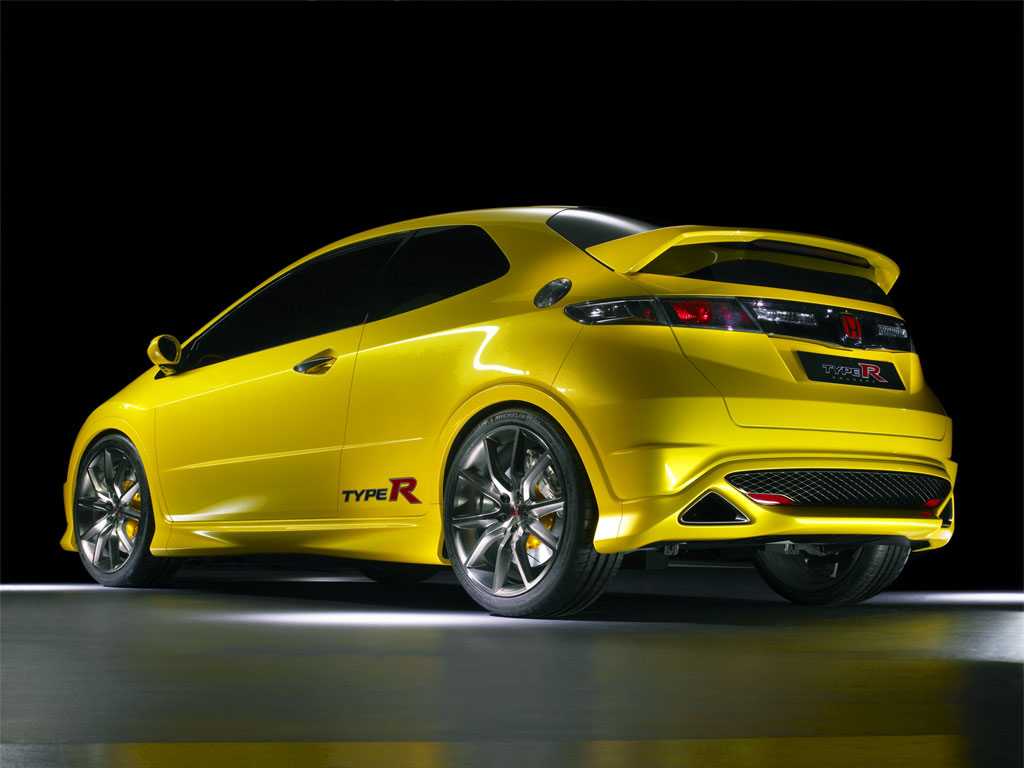
When Honda unveils a new sports concept there is always a sense of anticipation and the new Civic Type R is no exception. To please all its fans, Honda engineers have designed a 'superhatch' to deliver blistering performance from the same power output as the previous incarnation (200 bhp). The aggressive, lower and wider-looking body encases a new 2.0 liter engine and the model, built in Britain, will go on sale in early 2007 priced around £18,000.
What is a Type R?
The Type R name was introduced by Honda Motorcycles, where the letter R was added to conventional bike names to indicate a performance derivative. For example, the CB – a standard 4-cylinder across-the-frame bike – became the CB-R, a sporting model.
One of the earliest Type R cars was the Honda NSX-R, a stripped-down, lightweight version of the NSX supercar. This was developed in response to claims the NSX did not have enough power to compete with rival cars from Porsche and Ferrari. The key factor in this argument – and a point proved by the NSX-R – was the importance of the power to weight ratio.
Philosophy
The Type R philosophy is not about building the most powerful, or fastest car in the world. It is about creating a car that provides a well-engineered, but exciting driving experience. To offer this, every Type R needs to have certain key characteristics:
Racing: An exhilarating driving experience similar to that felt when piloting a racing car.
Involvement: High levels of feedback and involvement in terms of sound, steering response and handling. The driver should feel part of the machine.
Not just speed: Going fast is part of the Type R experience, but not everything. The Type R should have above average levels of performance in gear change quality, braking, steering and handling.
Pure: The driving experience should not be diluted or interfered with by driving aids or sound proofing that could detract from the driver’s involvement.
Stripped-out: A Type R is not equipped with luxuries such as satellite navigation, hands-free telephones or leather upholstery. It should look and feel like a racing car.
Engineering: To meet the aims set by the philosophy, a different approach is taken during the design and development of a Type R. Therefore, each car possesses a special set of engineering qualities.
Normally aspirated: No bolting on of a turbocharger to give silly power figures. All Type R engines are normally-aspirated, which deliver smoother power delivery throughout the rev range, allowing power to be transferred through the chassis more easily, improving traction and acceleration.
Torsional rigidity: A stiffer chassis improves the handling of the car in terms of balance and adjustability. This makes for a more involving drive.
Simple technology: No traction control, stability control or four-wheel drive. Or indeed any other driver aids that can distance the driver from the experience. Instead, a Type R is based on clever, but simple engineering solutions rather than electronic gadgetry.
Type R Time-line
February 1992: NSX-R introduced. Weight is reduced by 265 lbs. Recaro seats and MOMO steering wheel fitted. Stiffer suspension adopted. Production limited to 1995 units.
September 1995: Honda announces the launch of the DC2 Integra Type-R. The Integra Type-R is powered by the B18C 1.8-litre DOHC VTEC engine, specifically developed for the Integra Type-R, with 200 bhp at 8,000 rpm. Standard equipment includes a helical LSD, sports suspension, a front lip spoiler, a rear spoiler, alloy wheels, a leather wrapped MOMO steering wheel, Recaro seats, and a titanium shift knob.
August 1997: The EK9 Civic Type-R is launched in Japan. It is powered by an exclusively-developed 1.6-liter DOHC VTEC B16B engine that makes 185 bhp at 8,200 rpm. The lightweight B16B engine features a new valve system allowing higher engine speeds, reduced engine friction, improved breathing, and increased compression ratio. Main features of handling include increased body rigidity, reduced weight, sports suspension, torque-sensitive helical LSD, sports-tuned ABS, and Bridgestone Potenza RE010 tires.
Jan 1998: The Accord Type-R goes on sale in the UK, with a tweaked version of the H22A engine on board. In addition, the Accord Type-R boasts a limited-slip-diff, Recaro seats and a stiffer chassis.
July 2001: An updated version of the Integra Type-R (DC5) is launched for sale in Japan and USA. The special color of Championship White celebrates Honda’s first victory in F1. The DC5 Integra Type-R is powered by the K20A 2.0-liter DOHC i-VTEC engine with 220 bhp and a new 6-speed manual gearbox. The suspension adopts clever front suspension and reactive-link double wishbone rear suspension. The Integra Type-R is also equipped with Recaro front seats, a leather wrapped MOMO steering wheel, aluminum pedals, aluminum shift knob, exclusive aero parts and Brembo front brakes.
October 2001: A Type-R version of the 7th generation Civic is announced. It is built at Honda in the UK Manufacturing in Swindon, Wiltshire. The CTR – as it becomes known by enthusiasts – is powered by a 2.0-liter i-VTEC engine that produces 200 bhp. The Civic Type-R goes on to sell over 35,000 units and pick up numerous Hot Hatch of the Year awards.
February 2006: An all-new Civic Type R, based on a three-door version of the 2006 Civic is unveiled at Geneva Motor Show.
Friday, March 03, 2006
634HP Honda Delsol CRX
This is crazy. Turbocharged CRX up to 634hp. Sound produced from the car can even make a child cry.
http://videos.streetfire.net/
Monday, February 27, 2006
2 Litres VTEC challenge the S2000
2 Litres VTEC machines to go against the S2000. In this clip a B20C Civic Type R EK9 and a H22 Euro Accord R faces the S2000...
http://videos.streetfire.net
Thursday, February 23, 2006
Singapore Initial D?
This clip is produced by some of the racers wannabe in Singapore. Hear the roar of their Vtec machines.
http://www.youtube.com/w/not-so-fast?v=aSsw9EC-MGE
Tuesday, February 21, 2006
Damn fast Honda Civic eg6
Got this video in some forum. Street racing in Singapore featuring a damn fast eg6 and wrx.
1st gear top speed at 110km/h, wow fast.
http://www.youtube.com/watch?v=r1xTU9tl5T8
Wednesday, January 18, 2006
The Original Honda of Japan's K20A article
Fuel Economy, Ample Torque, Clean Emissions
- The i-VTEC provides it all depending on engine load -
The DOHC i-VTEC utilizes smart valve control technology
The i-VTEC system utilizes Honda's proprietary VTEC sytem and adds VTC (Variable Timing Control), which allows for dynamic/continuous intake valve timing and overlap control.
The demanding aspects of fuel economy, ample torque, and clean emissions can all be controlled and provided at a higher level with VTEC (intake valve timing and lift control) and VTC (valve overlap control) combined.

The VTC actuator, installed on the intake camshaft, is controlled by oil pressure, to allow for dynamic and continuous valve timing to fit the load of the engine.
Additionally, the intake manifold length can be adjusted.
Combined with the DOHC i-VTEC, in order to obtain both ample low/mid-end torque and high-end output, a rotary valve is used inside the dual-passage intake manifold.
During low/mid rpm,, the rotary valve is closed, while it opens during high rpm's. By varying the intake path length according to engine rpm, ample torque is gained at all rpm levels. Additionally, the rotary valve design is superior over past butterfly valve (flap) in that it reduces intake resistance.
Saturday, January 14, 2006
The K20A : Honda's 1st DOHC i-VTEC Engine

The K20A used in the new Honda STREAM is the first of the new generation i-VTEC engines. Eventhough the engine does not produce a humongous amount of power in absolute terms, the importance of the engine is that it tells us of the new technologies that Honda is working on, and directly indicates the technologies that will be used on the new generation i-VTEC super high-performance engines that is to come.
Do not judge the K20A by its mere 154ps power rating. What is important is not its specific power output but the sheer amount of technologies that Honda has put into it. It is truly a new generation VTEC engine - the DOHC iVTEC. As can be expected, a lot of wonderful current technologies have been carried over to the K20A, frequently enhanced in a way that makes the K20A overall a wonder-engine in its own way.
i-VTEC
i-VTEC introduced continuously variable camshaft phasing on the intake cam of DOHC VTEC engines. The technology first appeared on Honda's K-series four cylinder engine family in 2002. Valve lift and duration are still limited to distinct low and high rpm profiles, but the intake camshaft is now capable of advancing between 25 and 50 degrees (depending upon engine configuration) during operation. Phase changes are implemented by a computer controlled, oil driven adjustable cam gear. Phasing is determined by a combination of engine load and rpm, ranging from fully retarded at idle to maximum advance at full throttle and low rpms. The effect is further optimization of torque output, especially at low and midrange RPMs.
In 2004, Honda introduced an i-VTEC V6 (an update of the venerable J-series), but in this case, i-VTEC had nothing do to with cam phasing. Instead, i-VTEC referred to Honda's cylinder deactivation technology which closes the valves on one bank of (3) cylinders during light load and low speed (below 80 mph) operation. The technology was originally introduced to the US on the Honda Odyssey, and can now be found on the Honda Accord Hybrid and the 2006 Honda Pilot. An additional version of i-VTEC was introduced on the 2006 Honda Civic's R-series four cylinder engine. This implementation uses very small valve lifts at low rpm and light loads, in combination with large throttle openings (modulated by a drive-by-wire throttle system), to improve fuel economy by reducing pumping losses.
With the continued introduction of vastly different i-VTEC systems, one may assume that the term is now a catch all for creative valve control technologies from Honda.
Thursday, January 12, 2006
Honda Integra Type R

Introduced in '97 the Integra Type R is a track racer with all the practicalities of a normal car such as 4 seats, a usable boot and reasonable miles per gallon.
The Integra model had not been seen in the UK since '87. With the R denoting 'racing', the Integra Type R is lightened even down to the windscreen, stripped and strengthened, and some red badges.
The main feature this car has is the engine - a hand finished 1.8 litre, 100bhp per litre naturally aspirated VTEC engine. The B18 VTEC engine urging your to rev to the redline peaking 190bhp @ 7900rpm.
The UK car gets the Japanese Recaro interior - Red in the Championship White models and Black in the Black or Red variants. The US quad lamp front end was installed from the launch. The Japanese did not switch to this design until later so same year JDM imports may have the large rectangular lights.
As with many of Hondas cars build quaility remains high. A stainless steel exhaust is standard equipment, and is hard to improve on. A helical Limited Slip Differential is alkso standard fare to increase road holding - a great asset where so many manufacturers use computers to cut the fun.
The Integra Type R has gained a reputation as one of the best handling front wheel drive cars, thanks to impressive structural rigidity and double wishbone suspension front and rear.
Thanks to its ability both on road and on track the ITR is a great one car solution to having an everyday car and one for the weekend. Use on track can lead to the path of upgrades - though often at the expense of everyday ride or power delivery. It is worth noting that Honda put a great deal of research into attaining 100bhp per litre and into see gains on this will require careful selection of parts and a reasobale amount of money.
The ITR begs to be driven and is rewarding to do so. It does require dedication, with little low down torque, and VTEC not even engaging until around 6000rpm but put the effort in and the rewards are there. A lack of sound proofing adds to the experience as the VTEC switch over turns the engine note into an F1 howl all the way upto 140mph. The dash to 60mph comes up in 6.7 seconds, but it's not just about the raw acceleration. The whole package works so well together and even though it pushes the boundaries in technology it remains reliable.
The DC2 Integra Type R will no doubt claim a space in classic motoring in the future.
Wednesday, January 11, 2006
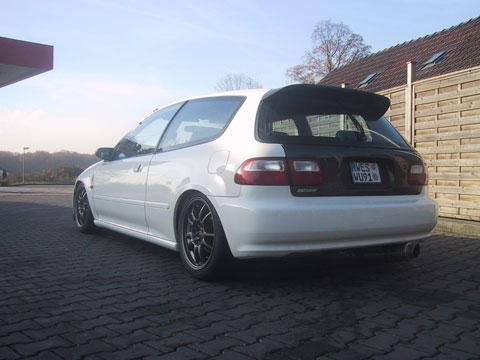
Honda Civic EG6 DOHC VTEC



Engine:
B16A2
Spoon Sports Thin Head Gasket
ARP headstruts
Hondata Headshield
MSD Ignition Wires
Ground Wiring Kit
Comptech Intake with JDM ITR Intake Box
AEM Cam Gears
AEM Fuel Pressure Regulator
Walbro Fuel Pump
RC 440cc Injectors
Hondata S200
Mugen Jasma 4-2-1 Header
High Flow Racing Cat
5 Zigen Fireball Cat Back Exhaust
K&N Air Breather
APEXi V-AFC2 Black
Chrome Fuse Box Cover
Spoon Sports Radiator Cap 1,35
Mugen Oil Cap
Mugen Valve Cover
Mugen,Spoon and Advan Reservoir Covers
Koyo ITR Radiator
VTEC Solenoid Chrome Cover
Blox Intake Manifold
64mm Throttle Body
Silicone Hoses Engine Dress Up kit
AC Fuel Rail
J's Engine Torge Damper
Exterior:
Seibon Carbon Fiber Hood OEM Style
VIS Carbon Fiber Trunk
Spoon Carbon Fiber Mirrors
Spoon Duckbill Carbon Fiber Wing
JDM Fog Lights
OEM Mud Flaps
JDM Window Visors
Seibon Carbon Fiber Frontlip
R1 Racing Tow Hook
Cusco License Plate Relocator
Vision Corner Lights
Interior:
DC-Sports Shortshifter
Carbon Fiber Dash trim
Spoon Sports Shiftknob
ITR Red Recaro Seats
APEXi V-AFC 2 Black
Carbon Fiber Autometer with Shift Light
Autometer Carbon Fiber Oil Temperature Gauge and Air Fuel
JDM ITR MOMO Steering Wheel
EK9 Floor Mats
JDM ITR Cluster
DOHC (double overhead cam) VTEC
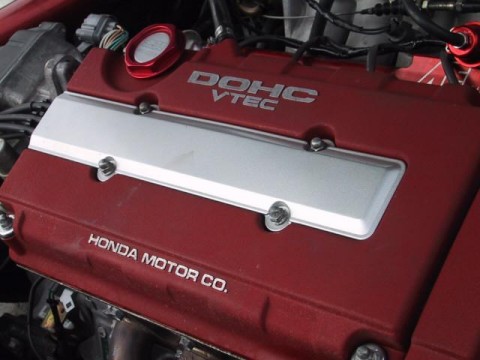
Honda's VTEC system is a simple and fairly elegant method of endowing the engine with multiple camshaft profiles optimized for low and high RPM operations. Instead of only one cam lobe actuating each valve, there are two - one optimised for low RPM smoothness and one to maximize high RPM power output. Switching between the two cam lobes is controlled by the engine's management computer. As engine RPM increases, a locking pin is pushed by oil pressure to bind the high RPM cam follower for operation. From this point on, the valve opens and closes according to the high-speed profile, which opens the valve further and for a longer time. The VTEC system was originally introduced as a DOHC system in the 1989 Honda Integra sold in Japan, which used a 160 hp (119 kW) variant of the B16A engine. The US market saw the first VTEC system with the introduction of the 1990 Acura NSX, which used a DOHC V6. The DOHC VTEC system has high and low RPM cam lobe profiles on both the intake and exhaust valve camshafts. This resulted in the most power gain at high RPMs and DOHC VTEC engines were thus used in the highest performance Honda automobiles. In contrast to the SOHC implementation which switches between cam profiles seamlessly, when the DOHC version switches cams there is a definite change in the engine note.
Monday, January 09, 2006
accident car florida lawyer , 21 auto century insurance , accident lawyer michigan , automobile law lemon , california car cheap insurance
accident car florida lawyer , 21 auto century insurance , accident lawyer michigan , automobile law lemon , california car cheap insurance
Make money with Google Adsense. These are some of the top paying keywords for adsense (unofficial).
accident car florida lawyer - $28.03
21 auto century insurance - $19.26
accident lawyer michigan - $19.03
automobile law lemon - $17.73
california car cheap insurance - $15.51
Subscribe to:
Posts (Atom)


